



Anthropic wanted to know the truth about how AI is changing our lives. They did not just ask experts in white coats. Instead, they used an AI to talk to 80,508 regular people from 159 countries. They wanted to know if this new tech is a “time machine” that gives us our lives back, or something we should fear.
TL;DR
Anthropic studied AI conversations from 80,000 people in 159 countries
People use AI to save time and reduce mental overload
Many rely on it for learning, work, and even emotional support
People feel both excited and worried at the same time
Biggest fears: job loss, bad info, and becoming too dependent
A Massive Global Conversation
Most news stories about AI are just guesses about what might happen in ten years. This study is different because it looks at what is happening to real people right now. Researchers used a special version of Claude to conduct interviews in 70 languages. This was not a boring “yes or no” form. It was a genuine conversation. The AI asked people “why” they use these tools, and it heard everything from business plans to 3 a.m. secrets.
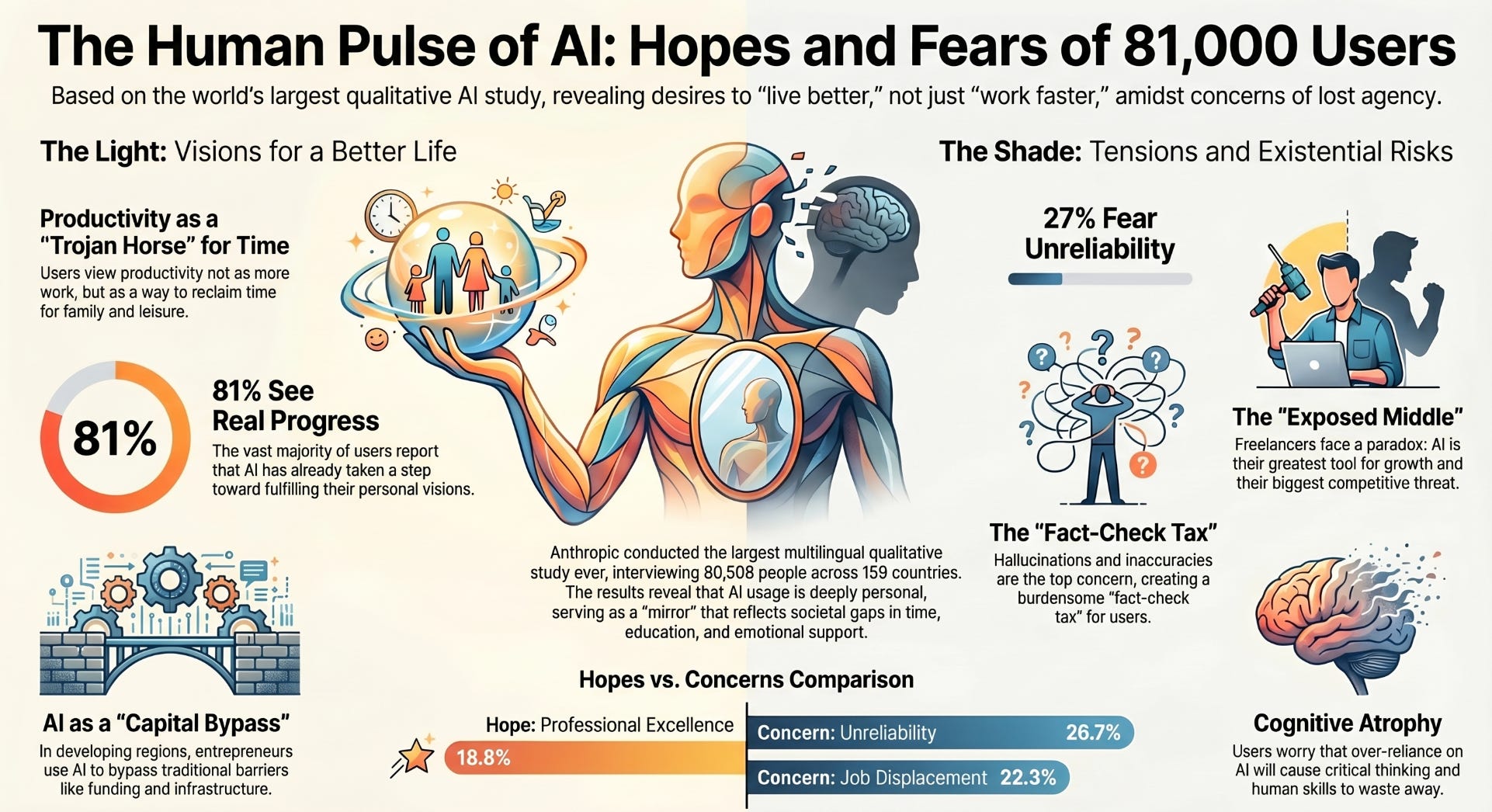
This study provides us with the “ground truth.” Because the AI was a good listener, it gathered stories that experts usually miss. The numbers are big: 80,508 people took part, and a huge 81% of them said AI is already helping them reach their goals. They talked to the machine like a friend because it had infinite patience and never made them feel small. We are moving past the hype. AI is no longer a movie robot; it is becoming a part of how we think and act every day. If you feel a mix of excitement and worry, you are not alone; thousands of others across the globe feel the exact same way.
Understanding how the study worked is important, but the real magic is in the stories people shared about their hopes for a better life.
The AI “Time Machine”
For a long time, bosses have seen AI as a way to get more work out of people. But regular people see it as a way to get their lives back. Many of us feel “brain-tired.” Our minds feel like a full suitcase that just won’t close because there are too many tiny tasks inside. People are using AI to handle the “boring stuff” so they can focus on what they love.
In this study, “doing better work” was the top goal for 19% of people. But for many, this was a “Trojan Horse.” They said they wanted to be better at work, but the real wish hidden inside was to get home earlier. A doctor in America used AI to handle the 150 daily messages from nurses so they could spend more time with patients. A software engineer in Mexico used it to finish work on time to feed and play with their kids. A butcher in Chile, who had almost never touched a computer, used AI to start a brand-new business. For these people, AI is a release valve for a world that feels too fast and too loud.
You don’t have to use AI to do more work. You can use it as a scaffold to help you stay focused or learn things in 30 seconds that used to take a month. It is a way to do the dull work so you have the energy left over for your family and your hobbies.
Even with all this hope, there is a dark side to these new tools that users are starting to notice.
Light and Shade of AI
Every good thing about AI has a “shadow” side. The study found that the people who love AI the most are often the ones who fear it the most. This is because hope and alarm are growing at the same time. While people are happy for the help, they have about two or three deep worries on average.
The biggest fear is that AI makes mistakes. About 27% of people worry that the machine will “hallucinate” or make up facts. There is also a fear that our brains will get soft if we stop doing our own thinking. A student in South Korea got great grades using AI but felt bad because they weren’t actually learning. A daughter whose mother had died used the AI as a “sponge” to hold her grief and guilt because she had no one else to talk to. While the AI helped her, she felt the “shade” of relying on a machine instead of a person.
Think of AI like a gym membership. If the machines at the gym lift the weights for you, you won’t get any stronger. Some struggle is necessary for us to grow. If we let the machine do everything, we might lose the skills that make us who we are. It is a great tool, but you must stay in the driver’s seat. Use it to help, but don’t let it replace your own mind or your real human friends.
These personal fears often look very different depending on where you live on the map.
A Tale of Two Worlds
Where you live changes how you see AI. In wealthy Western countries, people often see AI as a “wrecking ball” that might ruin their stable jobs and take away their privacy. But in other parts of the world, people see AI as a “ladder.” In places like Africa and South America, people are much more excited because they see AI as a way to climb out of poverty and start businesses without needing big loans.
In the West, people use AI to sort emails and manage their busy calendars. They worry about being watched by “bad actors.” But in the Global South, AI is an “equalizer.” A mute user in Ukraine worked with the AI to build a tool that speaks for him so he can talk to his friends in real time. An entrepreneur in Uganda said AI is the only way he can “stake a claim” in the market.
East Asia stands out, too. People there worry less about being watched and more about their brains getting soft. They often use AI to make money specifically so they can take care of their parents. AI is not just one thing. It is like a mirror that reflects whatever a society is missing. If a country lacks teachers, people use it to learn. If people are lonely, they use it for talk. Your view of AI is shaped by your life, and seeing how others use it might show you new ways to help yourself.
What This Means for You
At the end of the day, AI is not really about the machine. It is about us. This study shows that thousands of people are using AI to fill gaps in their lives. Some use it because they are tired. Others use it because they want to learn.
A user in Germany said it best: “AI should be cleaning windows and emptying the dishwasher so I can paint and write poetry. Right now, it’s exactly the other way around.”
The real goal of AI should not be just to do things faster. It should be about what we do with the time we save. If AI cleans the “digital windows” of your life, will you use that time to do something you love? The machine can give you back your hours, but only you can decide how to live a meaningful life. Use the tool, but keep your hands on the wheel.


